
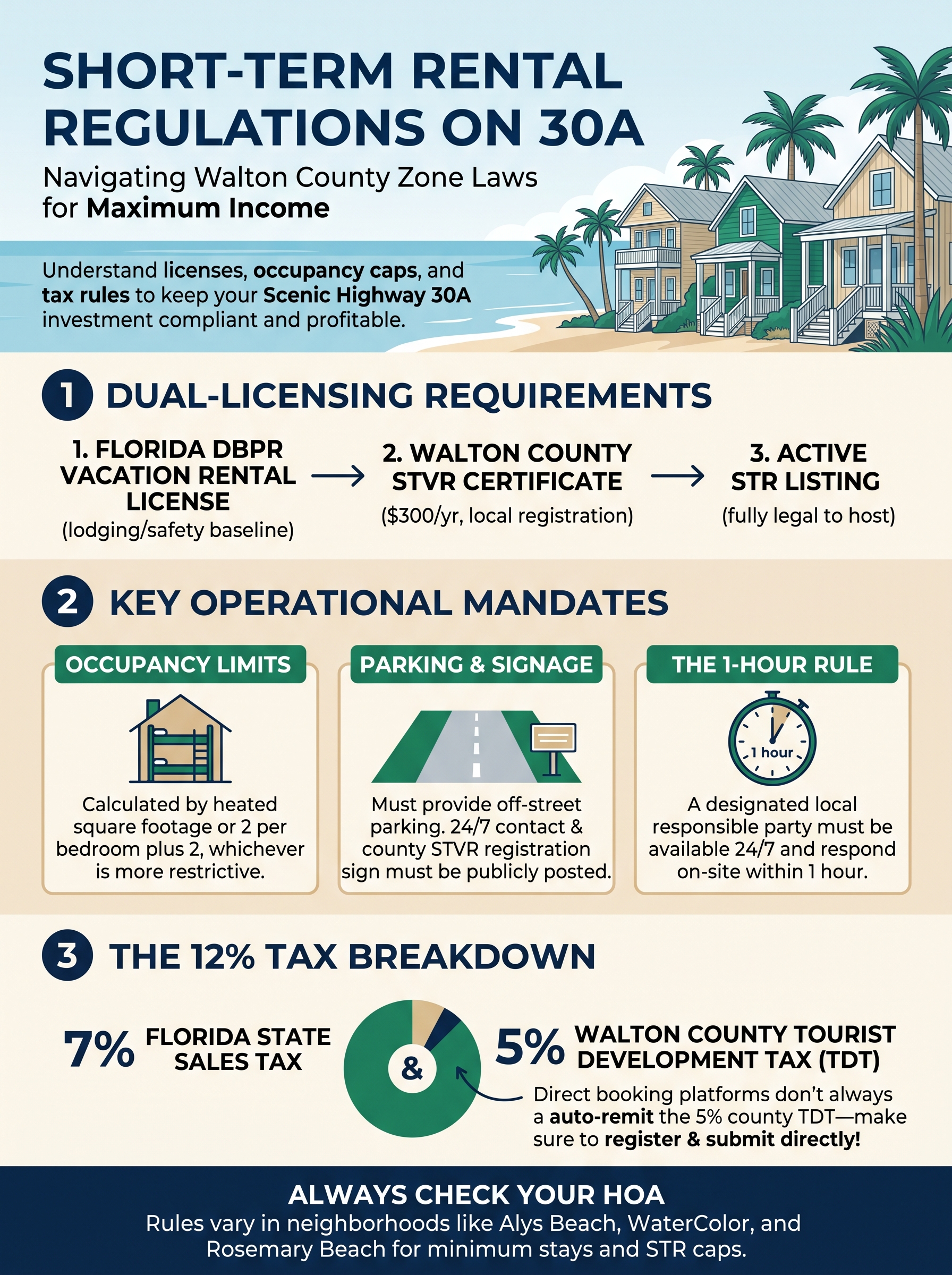
Investing in short-term rental (STR) real estate along Florida’s Scenic Highway 30A offers substantial revenue potential, but unlocking peak cash flow requires a clear understanding of regulatory compliance.
While Florida state law prevents local municipalities from outright banning short-term rentals, Walton County enforces precise ordinances regarding licensing, occupancy formulas, safety protocols, and tax collection. Furthermore, hyper-local HOAs and community overlay rules add an additional layer of governance.
Navigating these regulatory frameworks ensures your luxury property remains fully compliant while maximizing gross rental revenue.
1. The Dual-Licensing Requirement
Before listing a property on any vacation rental platform, property owners must secure two primary operating credentials:
[Florida DBPR Vacation Rental License] → [Walton County STVR Certificate] → [Active STR Listing]
Step 1: Florida DBPR License
Obtained through the Florida Department of Business and Professional Regulation (DBPR), this state-level lodging license establishes core safety and operational baseline standards.
Step 2: Walton County Short-Term Vacation Rental (STVR) Certificate
Once state licensing is active, owners must register with Walton County. The annual county certificate costs $300 per property ($227 for community-managed properties) and requires annual renewal.
2. Key Operational Regulations
To protect neighborhood character and maintain guest safety, Walton County enforces strict operational standards across unincorporated 30A:
Regulation | County Mandate | Impact on ROI & Property Value |
Occupancy Formula | Max 1 person per 150 sq. ft. of heated/cooled space, OR 2 people per bedroom plus 2 additional guests (whichever is more restrictive based on certification). | Drives demand for homes with efficient floor plans, bunk rooms, and generous livable square footage. |
Parking Constraints | Off-street parking must accommodate guest vehicles based on square footage. Street parking is strictly regulated. | Properties with dedicated driveways, garages, or carriage pads command higher occupancy rates. |
Local Responsible Party | A designated contact must be available 24/7 and able to respond to on-site issues within 1 hour. | Requires partnering with a responsive local property management company or concierge team. |
Required Signage | A exterior sign (max 216 sq. inches) displaying the registration number and county STR hotline must be posted publicly. | Ensures compliance during county inspections, preventing daily fines up to $500. |
3. County Taxes vs. Private HOA Overlays
Understanding tax obligations and private deed restrictions is critical when evaluating potential investment properties along 30A.
Tourist Development Tax (TDT) Collection
Short-term stays carry a 12% total tax rate (7% Florida Sales Tax + 5% Walton County Tourist Development Tax).
Investor Tip: Major booking platforms (like Airbnb or Vrbo) do not automatically remit the 5% Walton County TDT on direct bookings. Property owners must register directly with the Walton County Clerk of Courts and submit TDT monthly through the county portal.
Private HOA & Master Community Rules
While county zoning allows short-term rentals across unincorporated 30A, individual homeowners associations retain the right to impose stricter covenants:
Minimum Stay Requirements: Communities like Alys Beach, WaterColor, or Rosemary Beach may enforce 3-night, 7-night, or seasonal minimum stay rules.
Rental Restrictions or Caps: Certain neighborhoods limit rental density or require specific architectural/parking guidelines for rental homes.
4. Maximizing Yield Within Regulatory Limits
Perform HOA Due Diligence Early: Review Master Declarations and CC&Rs during the property inspection period to confirm rental terms align with your revenue targets.
Design for High-Yield Efficiency: Optimize livable square footage and add amenities like private heated pools or outdoor kitchens to increase average daily rates (ADR) without exceeding legal occupancy limits.
Automate Compliance: Partner with an experienced local 30A advisory team and management platform to seamlessly handle TDT filings, DBPR renewals, and local responsible party duties.
Disclaimer: Real estate regulations and local ordinances are subject to change. Consult with a licensed Florida real estate advisor, attorney, or CPA before making investment decisions.

Socials