
Florida has long held the title of America’s premier financial refuge, but this week’s 2026 midterm election results just solidified that reputation for a generation.
With voters approving Amendment 3, Florida is dramatically restructuring its property tax system. Florida voters cleared the required 60% threshold to pass landmark constitutional tax protections that significantly expand homestead exemptions and slash annual assessment caps on non-homestead properties.
Along scenic Highway 30A—from the cobblestone streets of Rosemary Beach and the iconic white architecture of Alys Beach to the coastal dune lakes of Grayton and WaterColor—this reform is rewriting the economics of luxury coastal ownership.
Pairing historic property tax limits with Florida’s bedrock constitutional ban on personal state income tax creates an unmatched financial landscape for high-net-worth buyers, primary residents, and luxury vacation home investors.
The Anatomy of the 2026 Property Tax Reform
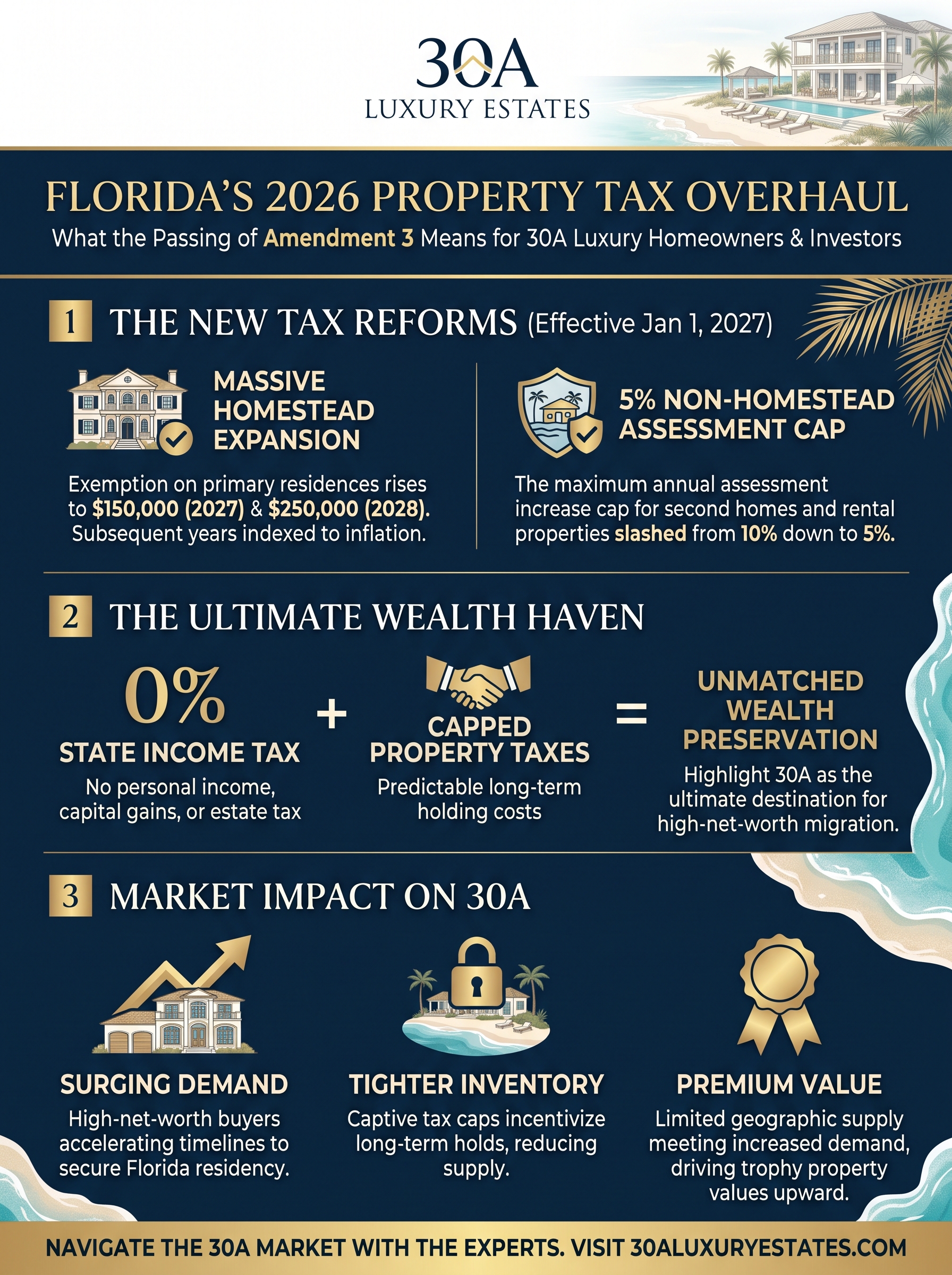
The passage of Amendment 3 introduces two critical shifts that take effect on January 1, 2027:
Massive Homestead Exemption Expansion: For primary homeowners who establish residency by December 31, 2026, the non-school homestead exemption jumps to $150,000 in 2027 and $250,000 in 2028, with subsequent years pegged to inflation.
The 5% Non-Homestead Assessment Cap: Crucially for second-home buyers and short-term rental investors, the maximum annual assessment increase cap for non-homestead residential properties drops from 10% down to 5% for non-school taxes.
1. The 5% Cap: Predictability for Luxury Second Homes and Vacation Rentals
A substantial portion of the 30A corridor comprises luxury second homes and vacation rental estates. Under the prior 10% assessment cap, multi-million-dollar coastal assets could face noticeable annual increases in taxable value during high-appreciation market cycles.
By halving that annual assessment cap to 5%, the state gives non-homestead owners an unprecedented safeguard against volatility:
Shielded Holding Costs: Holding multi-million-dollar beach homes becomes far more cost-predictable over 5-, 10-, and 20-year horizons.
Preserved Cash Flows for Luxury Rentals: Investors operating high-end vacation properties can underwrite long-term pro formas with tight caps on municipal tax inflation, protecting net operating margins against fluctuating local operating budgets.
2. The Full "Zero State Income Tax + Property Tax Haven" Synergy
For years, wealth migration to Northwest Florida was propelled by high-tax jurisdictions—California, New York, Illinois, and New Jersey—fleeing local income tax rates exceeding 10% to 13%.
Now, Florida’s tax advantage is no longer just about your W-2, business distribution, or capital gains:
No State Personal Income Tax: 0% on wages, pass-through entities, capital gains, or retirement income.
No State Estate or Inheritance Tax: Keeping generational family wealth intact.
Capped & Insulated Property Taxation: The existing "Save Our Homes" 3% cap on primary residences remains intact, amplified by the newly expanded $250,000 homestead baseline, while second properties gain the 5% shield.
When ultra-high-net-worth families compare holding a legacy coastal compound in the Hamptons, Newport, or coastal California against 30A, the disparity in total annual tax drag often measures in the hundreds of thousands of dollars annually.
What This Means for 30A Property Values and Buyer Demand
The 30A market is structurally defined by limited geographic supply. Sandwiched between the Gulf of Mexico and protected state forests and coastal dune lakes, land in Walton County cannot simply be manufactured.
When macro-policy permanently lowers holding friction, capital flows naturally accelerate:
Surging Inbound Luxury Demand: High-earning entrepreneurs, corporate executives, and remote family offices will accelerate timelines to establish permanent or partial footprints along the Emerald Coast.
Tighter Inventory (The "Lock-In" Wealth Effect): When properties carry an annual assessed tax cap of 3% (homestead) or 5% (non-homestead), legacy owners have strong financial incentives to retain their real estate for generations. Fewer trophy listings reach the open market, keeping luxury pricing firm.
Increased Trophy Asset Premium: Custom architectural builds in master-planned communities like Seaside, Alys Beach, and WaterSound Beach become even more coveted as strategic physical wealth preservation vehicles.
Navigating the Market with 30A Luxury Estates
Tax laws change, but the fundamentals of luxury coastal real estate remain constant: premier locations, timeless architecture, and long-term asset security.
Whether looking to acquire a primary beach compound to capture the homestead window before year-end or seeking an income-producing Gulf-front rental protected under the new 5% non-homestead cap, Robert Stenhammer at 30A Luxury Estates is here to guide you.

Socials